How to Play

Pax Pamir: Second Edition

1-5 players 45-120 min 8.1 Board Game Geek Rating

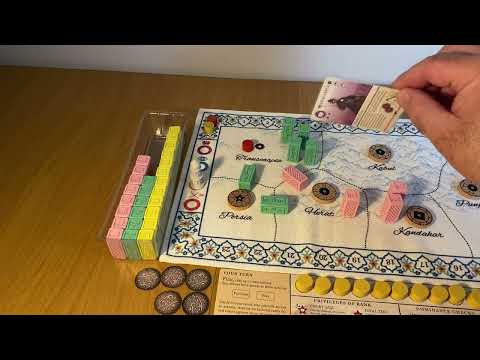
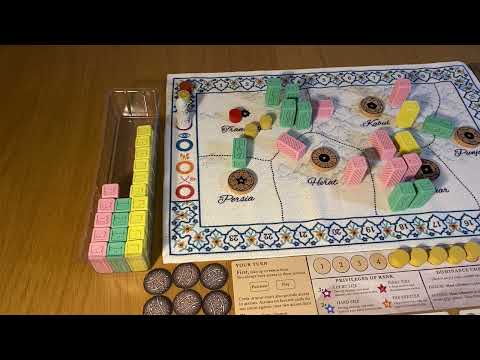
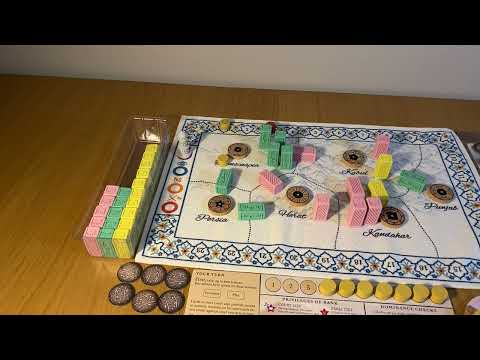
Afghan leaders navigate 19th-century power struggles, building courts of cards representing military units and political influence. Players form shifting coalitions while manipulating foreign empires for personal gain. Victory points are awarded during Dominance Checks based on either coalition loyalty or individual power. The game ends when someone leads by four points or after four checks.

Published 2019

Pax Pamir: Second Edition

Get Ready

Setup the game with these step-by-step instructions before diving into your turn.

1
Establish coalitions
Three coalitions exist in the game: British, Russian, and Afghan
2
Prepare the market
Arrange cards in rows to form the market where players will purchase cards
3
Set initial hand limit
Players start with a hand limit of 2 cards plus total blue stars in their court
4
Set initial court limit
Players start with a court limit of 3 cards plus total purple stars in their court
5
Place coalition blocks
Armies and roads for each coalition are placed in the supply tray
6
Distribute player cylinders
Each player receives cylinders on their player board for tribes and spies
7
Set starting loyalty
Each player begins with a position on their loyalty dial

On Your Turn

What you can do during your turn.

1
Take two actions
Perform up to 2 actions per turn, and you may perform the same action type twice
2
Use free actions
Actions on cards matching the favoured suit symbol do not count against your two-action limit
3
Purchase a card
Place 1 rupee on each card to the left of chosen card (2 rupees each if military suit is favoured), then take the card and any rupees on it to your hand
4
Play a card
Add a card from your hand to the left or right of your court
5
Place armies
White armies go in the specified region matching your loyalty; coloured armies force a loyalty change if different
6
Place roads
Place on borders of specified region matching your loyalty, leading to any adjacent region
7
Collect leverage
Take 2 rupees from the bank when playing a card with scales
8
Change preferred suit
Change the favoured suit symbol to match the card's symbol
9
Place spies
Take a cylinder from your board and place on any card with the same region name
10
Place tribes
Take a cylinder and place in the region matching the card's name
11
Rule a region
Control requires at least one tribe plus the most ruling pieces (your tribes + loyal armies) compared to other players
12
Tax
Take rupees from any market cards, or from players with court cards matching regions you rule (protected by their yellow stars)
13
Give gifts
Place a cylinder on any space on your loyalty dial, paying the indicated rupee cost to the market from the right
14
Build
Must rule a region; build up to 3 armies/roads in any ruled region at 2 rupees each
15
Move
Number of moves equals card rank; move one loyal army or spy per move along your roads
16
Move spies
Move one space left or right as if all courts form a circle
17
Betray
Pay 2 rupees to discard a card where you have a spy; all other spies return to owners
18
Battle with armies
Each of your armies destroys one enemy army/road/tribe of different loyalty, limited by card rank
19
Battle with spies
Each spy destroys one enemy spy on a court card, limited by card rank
20
Pay hostage bribes
Pay rupees equal to enemy spies if an opponent has more spies on your card than you do
21
Apply overthrow rule
Losing your last tribe in a region forces you to discard all political cards for that region; losing your last political card for a region removes all your tribes there
22
Clean up
Discard down to court limit and hand limit; pay 2 rupees to bag when discarding leverage cards or pay penalty; spies on discarded cards return to player boards
23
Trigger event cards
Event cards in the leftmost column trigger their top effect, then are discarded and market refills


Winning

How to claim victory.

1
Trigger dominance check
Occurs when any player buys a dominance card, when it reaches leftmost column, or when a second dominance card enters the market
2
Determine dominance
A coalition is dominant if it has 4 or more blocks on the map than any other coalition
3
Score with dominance
Players loyal to the dominant coalition count influence (gifts + prizes + patriots + dial symbol); most influence scores 5 VP, second scores 3 VP, third scores 1 VP
4
Score without dominance
Count cylinders each player has in play; most cylinders scores 3 VP, second most scores 1 VP
5
Handle ties
Sum tied point values and divide by number of tied players, rounded down
6
Remove pieces after dominance
If there was dominance, remove all armies and roads from the map
7
Check instant victory
If the first-place player leads by 4 or more VP after scoring, they win immediately
8
Double final scoring
The 4th dominance card doubles all points scored
9
Break final ties
Player with most red stars in court wins ties; if still tied, player with most rupees wins

watch & Learn

Let the pros teach you with these top videos.

【4K规则讲解】帕米尔和平:第二版 Pax Pamir 2nd Edition | 关于帝国坟场,阿富汗

【4K规则讲解】帕米尔和平:第二版 Pax Pamir 2nd Edition | 关于帝国坟场,阿富汗

Instructional

Pax Pamir [JcK Opina / Juego de Mesa / 2 Tomatoes]

Pax Pamir [JcK Opina / Juego de Mesa / 2 Tomatoes]

Review

MORE VIDEOS

FULL rules

Looking for the full details? Grab the complete rulebook as a downloadable PDF.

Play Board Games Online

Explore breakout hits and fan favourites with no downloads, setup or paywalls. Just click and play.

Play Now

more GAMES LIKE THIS