1
Understand the phases
Each game consists of 2 eras (A and B), each era has 4 rounds
2
Era transition
After era A ends, remove remaining field pieces and replace with 25 B-era pieces; game ends after era B concludes
3
Starting player places first
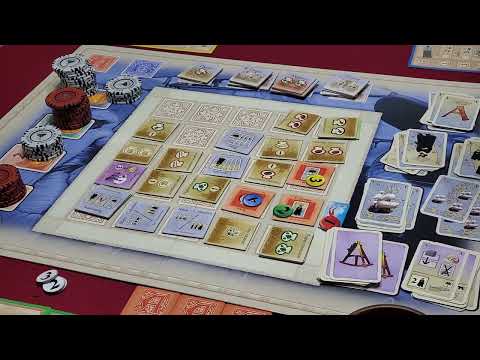
The starting player places the flag and their #1 numbered piece next to any row in the market area
4
Second player placement
The next player places their #2 numbered piece on one of the 25 pieces adjacent to the starting player's flag
5
Subsequent placements
Following players place their next numbered piece on a space touching the previous player's piece (one of the 8 surrounding spaces)
6
Complete the round
Continue until returning to the starting player, who places their next numbered piece following the same adjacency rules
7
No stacking numbers
Number pieces cannot be placed on spaces already containing number pieces
8
Flag placement options
The starting player's flag and #1 piece can be placed beside the market or on any empty market space, but must be directly adjacent to other pieces
9
Fallback placement
If a player cannot legally place their number piece, they may place it on any market piece
10
One bid per player per turn
Each player has one opportunity to bid
11
Auction order
Starting from the flag, pieces sell in numerical order; the owner of the number piece first declares a 0-coin starting price
12
Bidding begins
Starting from the left of the seller, bidding proceeds clockwise with minimum 1-coin bids or passing
13
Minimum raise
Each subsequent bid must increase by at least 1 coin
14
Outcome A - No bids
If no one bids (price remains 0), the number piece owner gets the tile for free; if it's the flag, add 1 reward action card
15
Outcome B - Seller passes
If the seller passes on their own piece, the highest bidder pays the seller and takes the piece
16
Outcome C - Seller buys
If the seller wants to buy, they pay 1 coin less than the highest bid to the bank
17
Continue auctions
After #1 piece sells, the #2 piece owner sells following the same rules until all pieces are sold
18
Medicine tiles
When acquiring a medicine piece, receive the medicines shown on it
19
Three actions per player
Each player performs 3 actions total
20
Action order
The flag holder (starting player) takes action #1 first, then clockwise each player takes their #1 action
21
Complete action rounds
After everyone completes action #1, the starting player takes action #2, then others follow; same for action #3
22
Track actions
After each action, the starting player places the action number marker on the board; at round end, return these markers
23
Development board advancement
Move your cube down on the development board by paying required ship cards and medicines; advance multiple steps per action if desired; medicines come from colony areas or plant pieces; earn 1 reward action card when reaching rows 2, 3, 4, or 5
24
Build navy
Take the indicated number of navy cards from the supply
25
Harvest
Receive the indicated number of any medicines, placing them on your fields or colony areas (excess returns to supply)
26
Collect taxes
Receive coins from the bank equal to the action's indicated value
27
Purchase reward cards
Pay 8 coins to buy 1 reward action card instead of other actions
28
Expedition
Draw cards from the expedition deck; each row shows two numbers—left is maximum cards to draw, right is maximum hand limit; if exceeding the limit, must play or discard one expedition card
29
Establish colony
Colonies cannot be gained directly through actions, only through certain pieces; when taking this action, establish one colony region requiring specific colonist amounts (Ceylon: 6, Cochin: 8, Madras: 10, Calicut: 12)
30
Colony establishment process
First check development board for colonist recruitment capacity, then draw 2 expedition cards (each shows colonist numbers at bottom), combine both totals, and if meeting the region's requirement, establish the colony; if short, use colonist cards from hand
31
Colony success
Take the region's piece, place on your board's designated spot, receive shown medicines, and place on the piece
32
Colony failure
If colonization fails, receive 1 colonist card from supply; discard both drawn expedition cards
33
Bonus actions available
After all players complete 3 actions, players may use bonus action cards for additional actions
34
Bonus action order
Starting with the starting player, take turns using cards if available
35
Bonus action options
Use one bonus action card to perform any of the 6 basic actions, or pass on bonus actions this round
36
Bonus card limit
Each player keeps only 1 bonus action card at round end; discard extras
37
Timing flexibility
Play expedition cards before, during, or after executing your turn's action
38
Card details
Specific card effects are listed in the game's rule reference guide







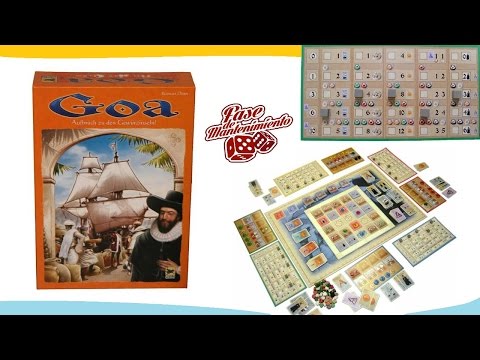

![[ENGsub] If this board game can change historical perspective. [Goa]](https://img.youtube.com/vi/e0KRGM4i620/hqdefault.jpg)